The short version
- Cash offers start from the after-repair value, then subtract repairs, holding costs, buying and selling costs, and the buyer's profit.
- If a wholesaler assigns your contract, the assignment fee also comes out of your price, so ask about it upfront.
- The 70% rule is an investor rule of thumb, not a law, and real offers vary.
- Compare your net from a cash sale to your net from listing, not the headline prices.
If you have asked a few companies for a cash offer on your house, you may have noticed the numbers are lower than what a neighbor's house sold for. That gap is not random. This guide walks through how cash buyers calculate your offer, line by line, so you can check the math yourself instead of taking anyone's word for it, including ours.
How cash buyers calculate your offer: the starting point
Almost every investor starts with one number: the after-repair value, or ARV. That is what your house would likely sell for once it is fixed up and looks like the nicer homes on your street.
To find it, the buyer pulls comparable sales, called comps. Good comps are recent sales, close by, and similar in size, age, bedrooms, bathrooms and lot. A remodeled three-bedroom on your block that sold a few months ago is a strong comp. A bigger house across the freeway that sold two years ago is a weak one. Small choices here move the whole offer, so it is fair to ask which comps a buyer used and why.
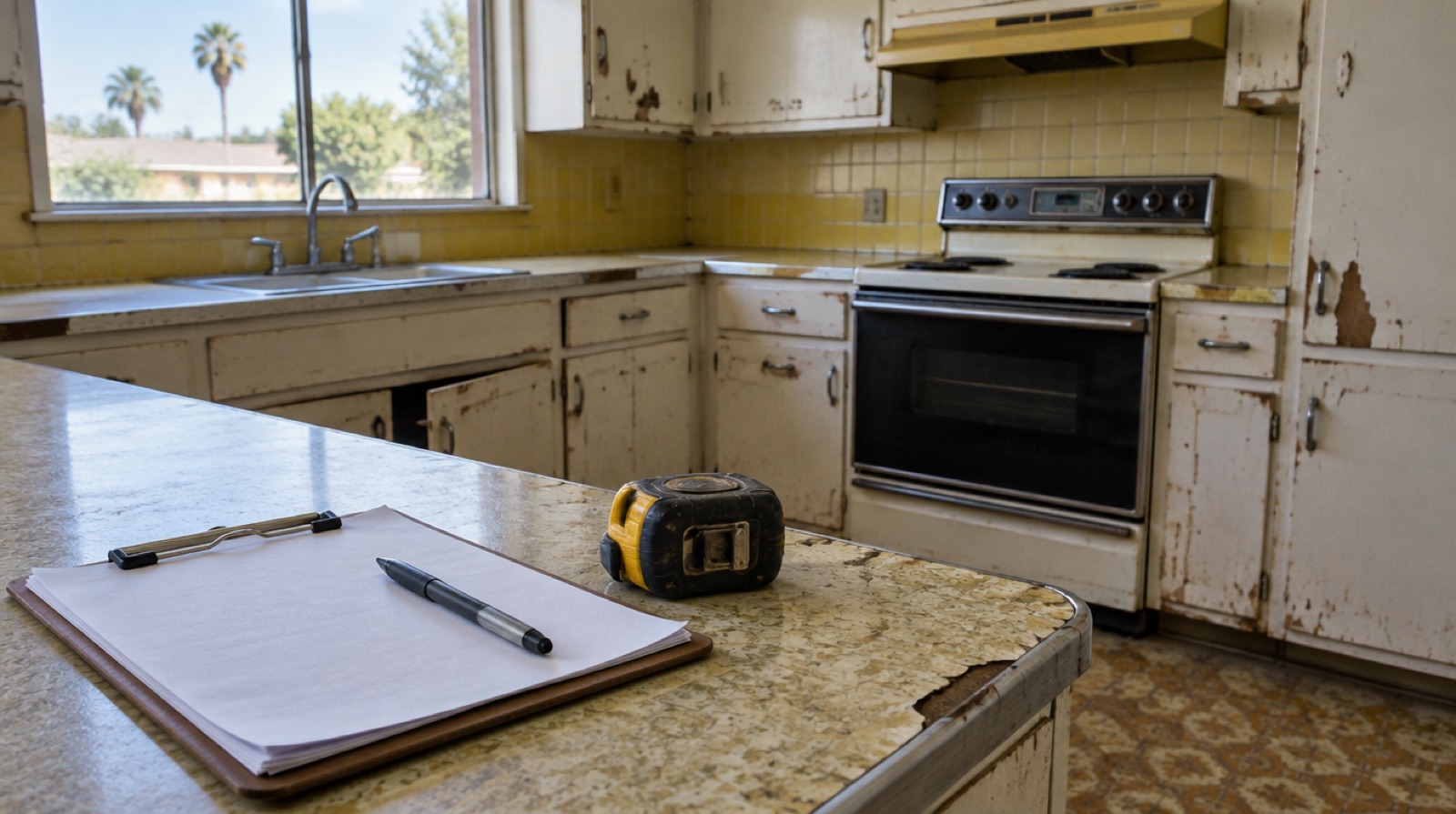
Next comes the repair estimate. The buyer walks the house and prices what it needs to reach that ARV: roof, plumbing, electrical, foundation, kitchen, bathrooms, flooring, paint and permits. Older homes in places like Pomona, Riverside or San Bernardino often hide surprises behind the walls, so many buyers add a cushion for problems they cannot see yet.
Holding, buying and selling costs
Fixing a house takes time, and time costs money. Those are holding costs, and they usually include:
- Loan interest. Many investors borrow short-term money at higher rates than a regular home loan, and they pay interest every month the project runs.
- Property taxes. In California, a sale is a change in ownership, so the county reassesses the house at its new value. The general rate is 1 percent of assessed value, plus any voter-approved bonds.
- Insurance on a vacant house under construction, which often costs more than a normal homeowner's policy.
- Utilities, plus things like security, yard care and trash while the work is going on.
Then there are the costs to buy and later resell the house: escrow and title fees, recording fees, and documentary transfer tax. California lets a county charge 55 cents for each $500 of value, and cities can add their own tax on top. When the investor resells, they usually pay agent commissions and more closing costs. Commissions are not fixed by law in California. State law requires listing agreements to say so in bold type.
The buyer's margin and assignment fees
After all the costs, the buyer needs a profit. That margin pays them for the risk that repairs run long, the market dips, or the house sits. A buyer who skips this line is either not being straight with you or will try to renegotiate later.
Some buyers are wholesalers. A wholesaler signs a contract to buy your house and then assigns that contract to another investor, who closes the deal. The wholesaler earns an assignment fee for finding the house and arranging the sale. That fee comes out of the same pot, so it lowers what the end buyer can pay you.
We want to be upfront: NexOffer may assign contracts. Sometimes we close ourselves, and sometimes we assign the deal to another buyer. Either way, you should know before you sign, and you should see the number you will walk away with in writing.
The 70% rule and a worked example
You may hear about the "70% rule." It is an investor rule of thumb, not a law. It says a buyer should pay no more than 70 percent of the ARV, minus repairs. It is a quick filter, not a real calculation, so actual offers can land above or below it. A house that needs only paint may get a better offer. A house with a cracked foundation, a slow local market, or high borrowing costs may get a lower one.
Here is a fully hypothetical example with round numbers for a Southern California house. It is not a real deal, and your numbers will be different.
- After-repair value: $700,000
- Repairs: $80,000
- Buying costs (escrow, title, transfer tax): $5,000
- Holding costs for about six months (interest, taxes, insurance, utilities): $28,000
- Selling costs when the investor resells (commissions and closing costs): $42,000
- Investor's profit margin: $70,000
- Highest price the end investor could pay: $475,000
- Assignment fee, if a wholesaler assigns the contract: $15,000
- Cash offer to you: about $460,000
Using the 70% rule on the same house gives $410,000 (70 percent of $700,000 is $490,000, minus $80,000 in repairs). The line-by-line method lands higher in this example, which shows why the shortcut is only a starting point.
How to compare a cash offer to listing
The fair way to compare is net to net: what lands in your pocket each way. When you list, subtract these from the expected sale price:
- Repairs or credits a retail buyer may ask for after inspection.
- Agent commissions, which you can negotiate.
- Your closing costs and transfer tax.
- Months of carrying costs: mortgage payments, taxes, insurance and utilities while the house is listed and in escrow.
- The chance that a buyer's loan falls through and you start over.
Say, in the same made-up example, you listed the house as-is for $600,000. After an assumed 5 percent in commissions and closing costs ($30,000), $10,000 in inspection credits, and three months of carrying costs ($9,000), you might net about $551,000. That is more than the $460,000 cash offer. If you can wait, handle showings and absorb the risk, listing may be the better choice, and we will tell you so.
Before you accept any cash offer, ask the buyer to show their math:
- What ARV did you use, and which comps support it?
- What repairs did you price, and for how much?
- What holding, buying and selling costs did you include?
- Will you close yourself, or might you assign the contract? If you assign, what is the fee?
- Who pays escrow, title and transfer tax, and what is my estimated net?
- Can the price change after an inspection, and why?
When a fast cash sale makes sense, and when it doesn't
A quick cash sale can be the right call when the house needs major repairs you cannot pay for, when you inherited a property and need to settle the estate, when you are behind on payments and running out of time, or when you simply cannot handle months of showings and repairs. Certainty and speed have real value, and only you can decide how much.
It usually does not make sense when the house is in good shape, you have time, and the market is steady. In that case, listing with a good agent will often net you more. You can also mix options: get a cash offer and a broker's price opinion, then compare the two nets side by side.
If you are in Los Angeles, San Bernardino or Riverside County, you can read more on our city pages, like we buy houses in Ontario, Rancho Cucamonga or Fontana, and request a no-obligation offer with the math written out.
This is general information
This article is not legal, tax or financial advice. Before you sign a contract, talk with a real estate attorney or tax professional. If you are behind on payments, a HUD-approved housing counselor can review your options for free or at low cost.
Questions sellers ask us most
What is ARV in a cash offer?
ARV stands for after-repair value. It is the price a buyer expects your house to sell for once it is fully fixed up. Buyers estimate it from recent sales of similar homes nearby, called comps. Because every other number is subtracted from it, the comps a buyer picks have a big effect on the offer you receive.
Is the 70% rule a legal requirement?
No. The 70% rule is a rule of thumb some investors use to screen deals quickly: pay no more than 70 percent of the after-repair value, minus repairs. It is not a law and not a fixed formula. Real offers move above or below it depending on repair costs, borrowing costs, local demand and how long the project will take.
What is an assignment fee?
When a wholesaler signs a contract to buy your house and then transfers that contract to another investor who closes, the wholesaler is paid an assignment fee. The fee comes out of the deal, so it lowers what you can be paid. NexOffer may assign contracts, and you can always ask any buyer whether they plan to assign and for how much.
Do I pay commissions when I sell for cash?
Usually not, if you sell directly to a cash buyer without hiring an agent. You may still have closing costs such as escrow, title or transfer tax, depending on what the contract says. Ask for a written estimate of your net. If you list with an agent instead, the commission is not fixed by law in California and can be negotiated.